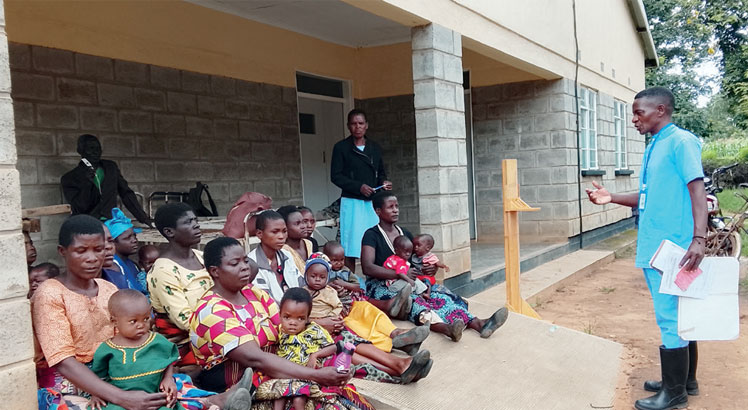
As dawn breaks over Nsalu Health Centre in Lilongwe, mothers arrive with babies strapped to their backs, seeking treatment for malnutrition.
The silent crisis worsened by climate change shatters the health, growth, learning and productivity of the youngest and most vulnerable Malawians.
Onolia Thauzeni’s twins—Promise and Prince, born last August 2025—were diagnosed with severe malnutrition.
“My children could have died because I didn’t have enough breast milk to feed them. I only eat once a day. Our crops failed due to the drought,” she says.
The food crisis has also wiped out her small doughnut business. Now, as the twins’ primary caregiver, she cannot work.
Meanwhile, her husband’s seasonal earnings from piecework in neighbouring fields remain insufficient to feed the family.
Thauzeni’s story is not isolated. Sofileti Banda, a divorced mother, also struggles to cope. Her husband left her in 2025, unwilling to raise a child with disability who required constant care in a home grappling with chronic hunger.
“We are suffering from hunger because we did not harvest enough grain,” she says. “I spend most of my time taking care of the child.”
Malawi faces a “triple burden” of malnutrition, with stunting, wasting and overweight conditions affecting children under five, according to Unicef. Of the country’s 3.3 million children in this age group, about one in three is stunted.
Climate change fuels the crisis as droughts, floods and erratic rainfall frequently disrupt agriculture, the backbone of the economy.
Lately, El Niño-induced dry spells have pushed millions into hunger, with more than four million people requiring food aid.
According to health surveillance assistant Enock Bwanali, Nsalu Health Centre admits about five malnourished children every week, exceeding 20 cases a month. Currently, 40 children are under a nutrition treatment plan that typically lasts four weeks, but can stretch to 12 for a child with severe malnutrition.
Bwanali says economic desperation forces families to make difficult decisions.
“In some cases, grandmothers take over infant care so that mothers can seek casual work, cutting breastfeeding short and further compromising children’s nutrition,” he says.
Some community leaders like village head Kabuthu promote better nutrition and climate adaptation practices.
The traditional leader encourages farmers to use organic manure such as Mbeya to improve soil health and get bumper harvest despite climate change.
Government, according to the National Multi-Sector Nutrition Policy, aims to reduce malnutrition through coordinated efforts across sectors.
Despite some progress in reducing underweight children, stunting rates remain high.
Authorities and partners have ramped up community awareness and the provision of therapeutic foods to support recovery while building long-term resilience to malnutrition and climate shocks.
For example, Njira Impact’s nutrition programmes support over 25 000 people in Thyolo, Nkhotakota and Phalombe districts to adopt climate-smart agriculture, including drought-tolerant crops and restoration of degraded watersheds.
Globally, efforts are also intensifying. The African Union’s nutrition strategy aligns with the global Sustainable Development Goals to end hunger, malnutrition and inequality by 2030.
Meanwhile, there is growing international attention to malnutrition as a direct consequence of climate change.
CoP30, the global climate conference held in Brazil last year, elevated malnutrition from a secondary concern to a primary consequence of the climate crisis amid rising cases of child malnutrition in constrained communities like Nsalu, where climate change and food insecurity intersect.
Yet, amid the uncertainty, mothers’ continued resilience underscores both the human cost of the crisis and the urgent need for sustained action to secure a healthier and more resilient future.
This article was published by financial support from the Media for Environment, Science, Health and Agriculture (Mesha) and International Development Research Centre, eastern and southern Africa.
AYOBE